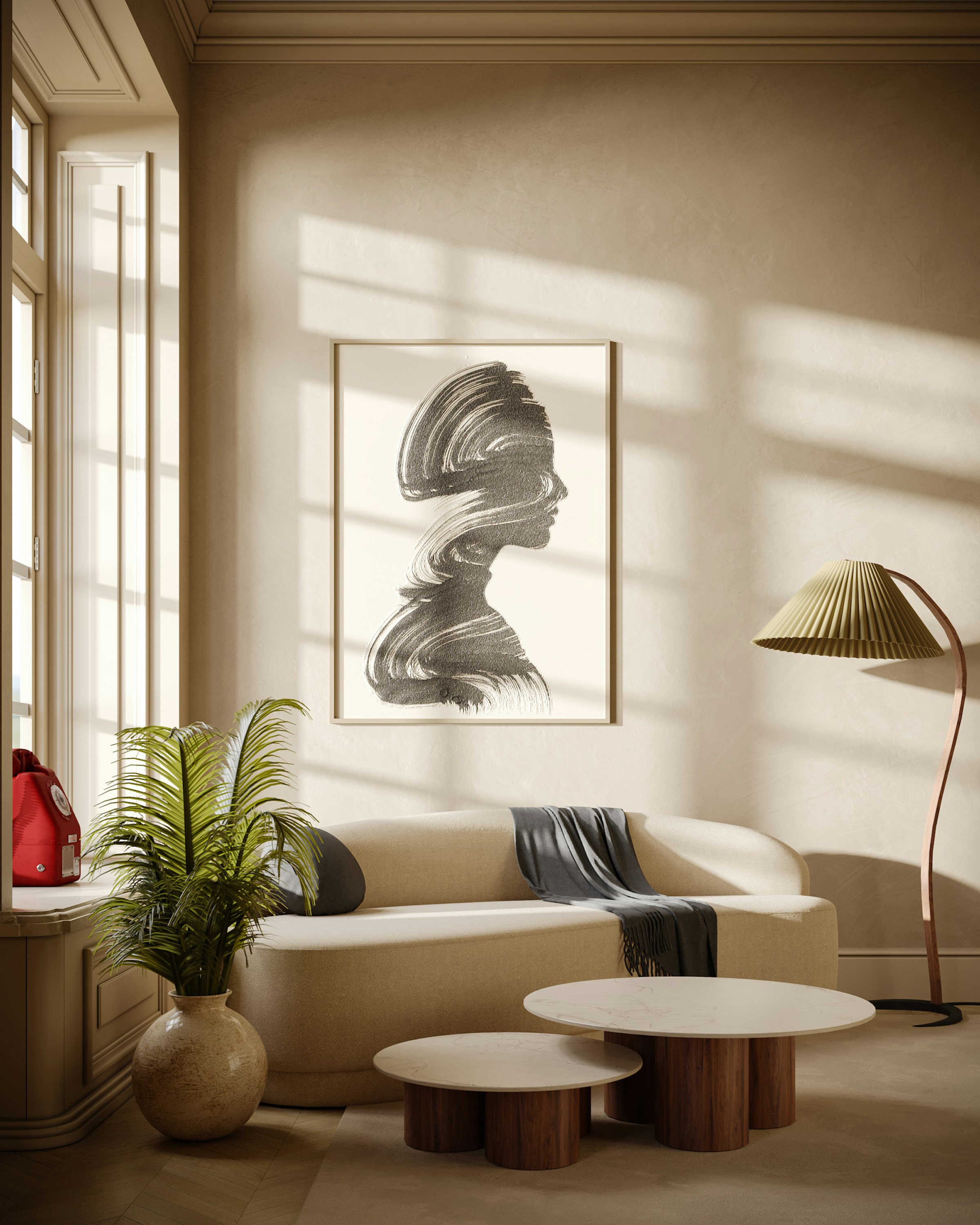
A neutral room that feels cold usually has plenty of the right colors and none of the right textures. Warmth comes from variation: in surface, in light, in the depth of one beige against another. Here is where to add it.
Layer textures, not colors
In a single-color scheme, texture does the work color would do elsewhere. Aim for at least five distinct surfaces in view: a nubby wool rug, a smooth linen sofa, a ribbed or bouclé chair, a wood table with visible grain, a ceramic or stone object. If everything is smooth, add something rough; if everything is matte, add one thing with sheen.
Warm the light, and layer it
One overhead fixture makes any room feel like an office. Add a floor lamp, a table lamp, and ideally a third source at a different height, all on warm bulbs (2700K is the safe choice). Shades in linen or paper glow; opaque shades throw light down and leave walls cold. If a single change would do the most, it is this one.
Add real wood
Wood is the most reliable warming material. A walnut side table, an oak stool, a wood picture frame. Mid to dark tones warm faster than pale ash; one or two pieces are enough.
Introduce contrast
All-light rooms wash out. A dark element, a charcoal lamp, a black metal frame, an espresso wood, gives the light tones something to be light against. Small doses are enough.
Vary the neutrals
Beige, cream, oat, greige, camel, and taupe are all neutral and all different. A room that uses three of them reads richer than one that uses a single shade throughout. Keep the undertones consistent (all warm or all cool) so they read as family rather than mismatch.
Soften the edges
Curtains to the floor, a throw over the arm, a rounded ottoman instead of a square table, a plant with real leaves. Hard-edged rooms feel cold in any color. Soft-edged rooms feel warm in any color.
None of this requires a bolder palette. It requires the neutral room to have as much variety in touch and light as a colorful room has in hue.