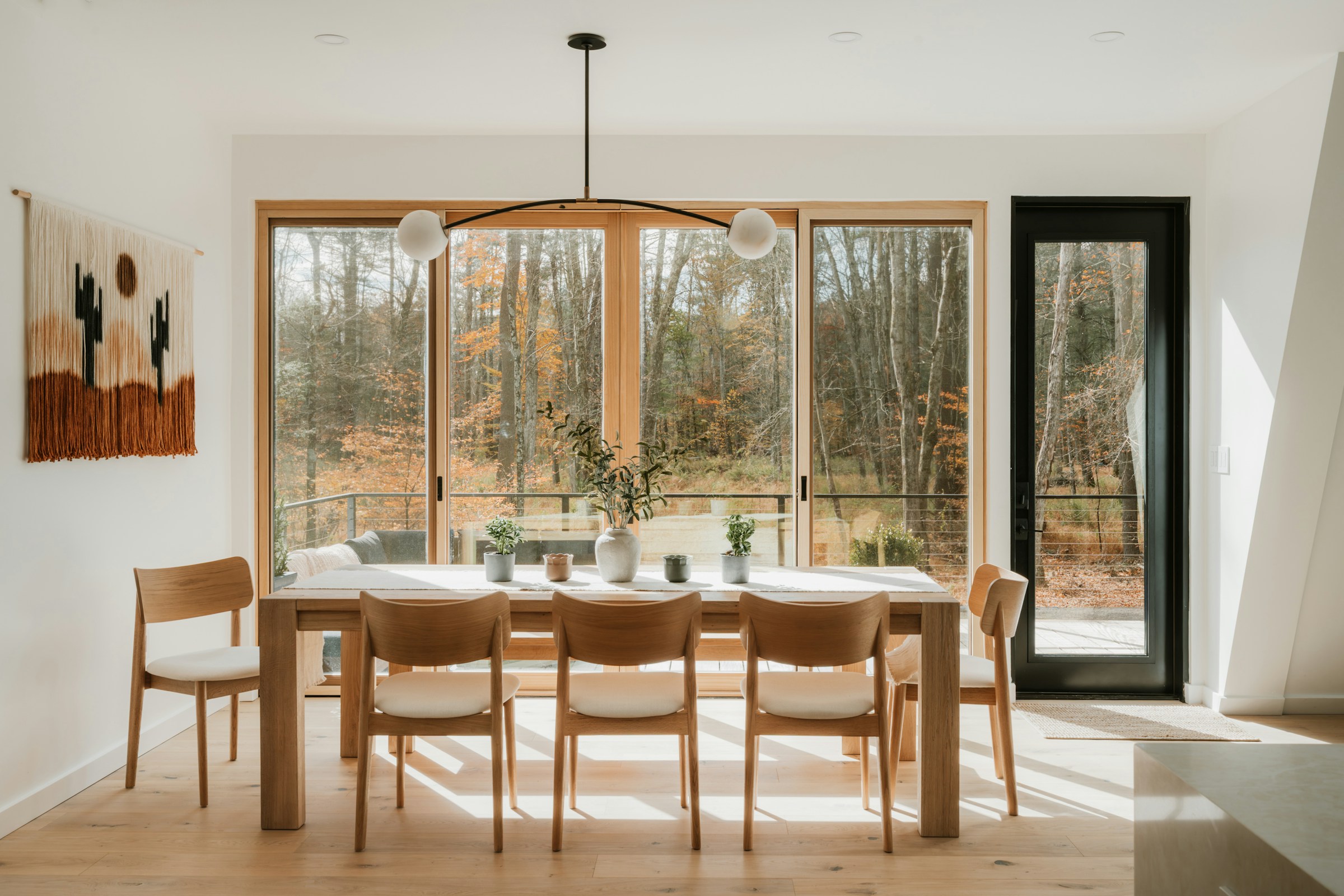
Most dining tables are bought a size too large. The table looks fine in the showroom and in the product photo, then the chairs go in, someone tries to walk behind a seated guest, and the room stops working. The fix is to size from the outside in.
Start with clearance, not the tabletop
A chair needs about 18 to 20 inches to pull out and let someone sit. A person walking behind a seated guest needs roughly another 16 to 18 inches. Put together, plan on 36 inches from the table edge to any wall or piece of furniture on sides where people need to pass, and 42 inches if that side is a main path through the house. On a side that is only ever for sitting, 30 to 32 inches is workable.
Subtract those clearances from the room's dimensions and you have the maximum table footprint. In a 10-by-12-foot room with a walkway on the long sides, that leaves a table roughly 48 inches wide and no longer than about 72 inches.
Seats per person
Give each diner about 24 inches of table edge for comfort, or 22 inches if the chairs are armless and you are fine with a closer table. A 72-inch rectangular table seats six comfortably (three per side) and eight only if the chairs are narrow and the end seats are used. A 36-inch-wide table is the practical minimum for serving dishes down the middle; 38 to 42 inches is more generous.
Round, rectangular, or oval
Round tables are the most forgiving in small square rooms because there are no corners to walk around, and everyone can see each other. A 42-inch round seats four; 48 inches seats four to five; 54 to 60 inches seats six. Beyond 60 inches, a round table becomes hard to reach across and rectangular or oval usually makes more sense. Oval tables give the seating of a rectangle with the softer circulation of a round; they are underused in rooms that are just slightly too tight for a rectangle.
Pedestal or legs
A pedestal base frees up the corners and lets you squeeze in an extra chair; four legs at the corners limit seating to the space between them. If you plan to seat the maximum, look at where the legs land relative to the chairs before ordering.
When smaller is better
An extension table is often the right answer for a room that hosts occasionally: a 60-inch table with one leaf covers most weeks and stretches to 78 inches for holidays. It costs less in daily circulation than a permanently large table and is usually cheaper than buying big and regretting it.
Quick checklist
- Measure the room and subtract 36 inches on every side with foot traffic.
- Allow 24 inches of edge per person.
- Consider round or oval for square or tight rooms.
- Check chair arm height against the apron height of the table; arms that do not tuck under waste space.
- Tape the footprint on the floor before you buy.